FinTech Market Report 2026-2032: Institutional Adoption, Regional Shifts,

Wire Service Editor
FinTech Market Report 2026-2032: Institutional Adoption, Regional Shifts, and Investment Dynamics
A comprehensive new report from Hiswai provides a data-driven roadmap for the global fintech industry, revealing a market that is maturing rapidly amid shifting investment patterns, deepening institutional engagement, and divergent regional trajectories. The report, titled The FinTech Revolution: Market Dynamics, Innovation Trends, and Strategic Opportunities, projects the sector’s valuation through 2032 and unpacks the funding cycle dynamics that are reshaping competitive landscapes.
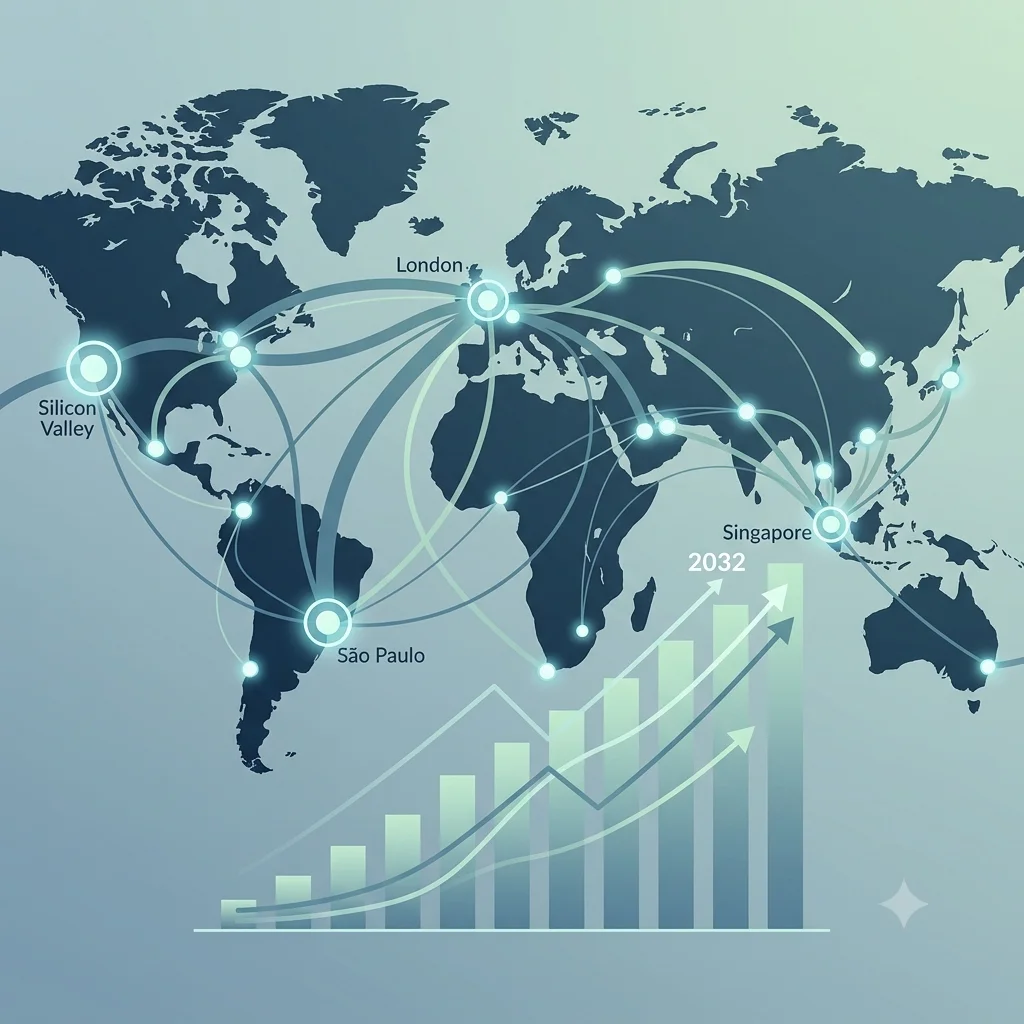
[IMAGE: A sleek, modern graphic showing a world map with glowing nodes representing fintech hubs (San Francisco, London, Singapore, São Paulo), connected by flowing lines of varying thickness to indicate investment flows. In the foreground, a stylized bar chart with upward trend lines and a '2032' annotation. Color palette: muted blues, teals, and soft greens. No text or watermarks.]
Market Overview: The State of Fintech in 2026
The global fintech market in 2026 presents a picture of disciplined evolution. After years of exuberant early-stage funding that poured into countless startups, the landscape has pivoted toward more selective, value-driven capital allocation. According to the Hiswai fintech market report, total investment in fintech reached an estimated $210 billion in 2025, a figure that represented a 12% year-over-year decline from the peak of 2024, yet was notably more concentrated in later-stage deals and B2B platforms with clear revenue models. This correction, far from signaling a downturn, reflects a healthy recalibration—investors are now demanding profitability milestones, regulatory clarity, and proven scalability before committing large sums.
Funding pattern fluctuations are evident across deal stages. Seed and Series A rounds have contracted as early-stage investors become more risk-averse, while growth-stage and mega-rounds (above $100 million) have held steady, driven largely by institutional capital. The report highlights that the average deal size in the fintech sector has increased by 18% since 2023, underscoring a “flight to quality” that rewards incumbent challengers and established digital platforms.
Regional growth variations are becoming more pronounced, and this is where the 2026 market offers its most strategic insight. While North America remains the largest fintech market by absolute value—accounting for approximately 38% of global investment—its growth rate has moderated to a single-digit annual increase. The Asia-Pacific region, by contrast, is experiencing a compound annual growth rate (CAGR) of 16.5%, driven by surging digital payments adoption in India, Indonesia, and Vietnam, as well as rapid expansion of neobanking in China and Japan. Latin America has emerged as a surprise powerhouse: fintech investment in Brazil and Mexico grew 32% year-over-year in 2025, fueled by open banking mandates and a thriving embedded finance ecosystem.
[IMAGE: A world heatmap highlighting investment growth rates by region, with callouts for key markets such as India, Brazil, Singapore, and the United Kingdom. Lighter shades indicate lower growth; deeper blues and teals denote double-digit CAGR regions.]
Europe, meanwhile, is undergoing a regulatory-driven transformation. The implementation of PSD3 and the EU’s Digital Finance Package has accelerated institutional collaboration, while the United Kingdom—post-Brexit—has reaffirmed its role as a global fintech hub through targeted policy support and a vibrant startup scene. The Middle East and Africa, though smaller in volume, show outsized potential: Saudi Arabia’s Vision 2030 and Nigeria’s mobile money boom have attracted significant venture capital, positioning these regions as the next frontier for fintech expansion.
Institutional Adoption: The New Frontier
Perhaps the most transformative shift documented in the Hiswai report is the deepening integration of fintech solutions within traditional financial institutions. This is not a new trend, but its pace and breadth have accelerated markedly since 2024. Banks, insurers, and asset managers are no longer merely experimenting with fintech partnerships—they are embedding digital capabilities into core operations, from payments and lending to compliance and wealth management.
The report estimates that institutional adoption of fintech—defined as the active procurement of B2B fintech services by financial incumbents—will account for over 60% of total fintech revenue by 2028, up from 45% in 2025. Key drivers include the need to modernize legacy infrastructure, meet evolving customer expectations, and navigate an increasingly complex regulatory environment. In particular, RegTech (regulatory technology) and compliance-related fintechs have seen a surge in institutional demand, with spending on anti-money laundering (AML) and know-your-customer (KYC) solutions growing at a CAGR of 22% from 2023 to 2026.
This institutional shift is reshaping the competitive landscape in several ways. First, it favors platforms that offer scalability and interoperability—fintechs that can seamlessly plug into existing bank systems gain a distinct advantage over point solutions. Second, regulatory alignment has become a prerequisite for institutional deals: startups with deep expertise in compliance frameworks, data privacy (GDPR, CCPA, and emerging AI governance rules), and cybersecurity are commanding premium valuations. Third, the rise of embedded finance—where non-financial brands integrate banking, lending, or insurance services—has blurred the lines between fintech, Big Tech, and traditional banking, creating a complex web of competition and collaboration.
[IMAGE: An infographic showing a bank icon merging with a fintech icon, with arrows indicating collaboration flows: regulatory compliance, data sharing, API integration, and co-branded products. Text labels: “Institutional Adoption Drivers” and “Key Synergies.”]
The report identifies four institutional adoption categories that are gaining momentum: payments and remittances (where banks are white-labeling fintech payment rails to reduce costs), lending and credit scoring (leveraging alternative data for underserved segments), asset and wealth management (robo-advisors and digital portfolio platforms), and insurance technology (digital underwriting and claims processing). Each category carries distinct strategic implications for stakeholders—investors should look for fintechs with strong institutional reference clients, while executives need to assess whether to build, buy, or partner to close capability gaps.
Projecting the Future: Market Valuations by 2032
The Hiswai fintech market report extends its analysis well beyond the current cycle, offering detailed projections for 2032 that serve as a long-term roadmap for investors and strategists. The report forecasts that the global fintech market—encompassing digital payments, lending, insurance tech, wealth management, RegTech, and blockchain-based services—will grow from an estimated $750 billion in total transaction value in 2026 to approximately $2.1 trillion by 2032, representing a CAGR of 18.3%. These fintech valuations 2032 projections are grounded in current funding patterns, adoption curves, and demographic trends.
Three key drivers underpin this trajectory.
First, evolving regulatory frameworks. The push toward open banking, centralized digital currencies (CBDCs), and harmonized cross-border payment standards will create new infrastructure layers that lower barriers to entry and expand addressable markets. The report notes that 85% of countries are expected to have some form of open banking regulation in place by 2030, up from 60% in 2025. This will particularly benefit fintechs specializing in data aggregation, API management, and digital identity verification.
Second, technological breakthroughs. Artificial intelligence and machine learning are no longer niche tools—they are becoming the backbone of credit risk assessment, fraud detection, conversational banking, and personalized financial advice. The report projects that AI-driven fintech applications will generate over $400 billion in incremental value by 2032. Meanwhile, blockchain and distributed ledger technology, while still maturing, are gaining traction in trade finance, cross-border payments, and tokenized assets. The convergence of AI, blockchain, and embedded finance is expected to create entirely new categories of “composable” financial services that can be assembled on demand.
Third, demographic shifts. The world’s unbanked and underbanked population—still estimated at 1.4 billion adults—represents a vast growth frontier. Fintech solutions tailored to mobile-first, low-income, and rural consumers are expanding rapidly in Sub-Saharan Africa, South Asia, and parts of Latin America. The report forecasts that digital-only banks and mobile money platforms will capture 40% of new banking customers in emerging markets by 2030. In mature markets, aging populations are driving demand for retirement planning tools and digital wealth management, while Gen Z and millennials—who are three times more likely than older cohorts to use fintech apps—are pushing incumbents to innovate or lose market share.
[IMAGE: A line chart projecting fintech market size (in trillion USD) from 2026 to 2032, with annotations for inflection points: “Open Banking Regulatory Peak (2028),” “AI-Driven Lending Breakout (2029),” “Embedded Finance Mainstream (2031).” The chart shows a steady upward slope with slight acceleration after 2029.]
The report also warns of potential headwinds: regulatory fragmentation across jurisdictions, concerns over data privacy and algorithmic bias, and the risk of a macroeconomic slowdown that could compress funding cycles. However, the base case suggests that the fintech revolution is still in its early growth stages, and that the companies that build scalable, compliant, and customer-centric platforms today will be well-positioned to capture disproportionate value in the coming decade.
Strategic Takeaways and Report Accessibility
The findings of the Hiswai report carry clear implications for different stakeholder groups. For investors, the message is to look beyond the hype of early-stage buzzwords and focus on fintechs with proven unit economics, strong institutional partnerships, and defensible moats in regulatory compliance. The shift toward mature, selective investments means that later-stage opportunities—particularly in B2B infrastructure, RegTech, and embedded finance—may offer the most attractive risk-adjusted returns.
For executives at both fintech companies and traditional financial institutions, the report underscores the urgency of building strategic ecosystems. No single company can master all aspects of technology, regulation, and customer experience alone. Successful players will be those that forge alliances, develop open APIs, and invest in talent that bridges finance and engineering. Understanding regional nuances is equally critical: the growth dynamics in Southeast Asia differ markedly from those in Latin America or the Middle East, and a one-size-fits-all strategy will fail.
For policy analysts and regulators, the report provides a data-backed foundation for crafting policies that foster innovation while maintaining financial stability. The emergence of embedded finance and digital currencies creates new challenges around consumer protection, systemic risk, and cross-border oversight. The Hiswai analysis suggests that forward-looking regulators should prioritize sandbox environments, interoperability standards, and international coordination to avoid a fragmented global payments system.
The full report—The FinTech Revolution: Market Dynamics, Innovation Trends, and Strategic Opportunities—is available from Hiswai, priced at $595.00. Copyrighted in 2026, it includes comprehensive segment analyses, country-level breakdowns, detailed profiles of leading fintech companies, and proprietary models for forecasting market size and investment flows. For decision-makers aiming to capitalize on fintech’s next wave, this report delivers the intelligence needed to navigate a landscape that is increasingly defined by scale, regulatory mastery, and regional specificity.
[IMAGE: Cover image of the report ‘The FinTech Revolution: Market Dynamics, Innovation Trends, and Strategic Opportunities’ (stylized mockup). The cover features geometric patterns, a graph arrow rising from left to right, and subtle icons representing payments, blockchain, AI, and banking. Text: “Hiswai Research 2026.”]
As the fintech market evolves from a collection of experimental startups to a deeply integrated pillar of the global financial system, the ability to differentiate signal from noise becomes paramount. The Hiswai report offers a clear, evidence-based lens through which to view that evolution—not as a story of boom and bust, but as a sustained transformation shaped by institutional adoption, regional shifts, and disciplined investment dynamics.
