The Intelligent Enterprise: How Multimodal AI, Blockchain, and IoT Are Redefining

Visual Journalist
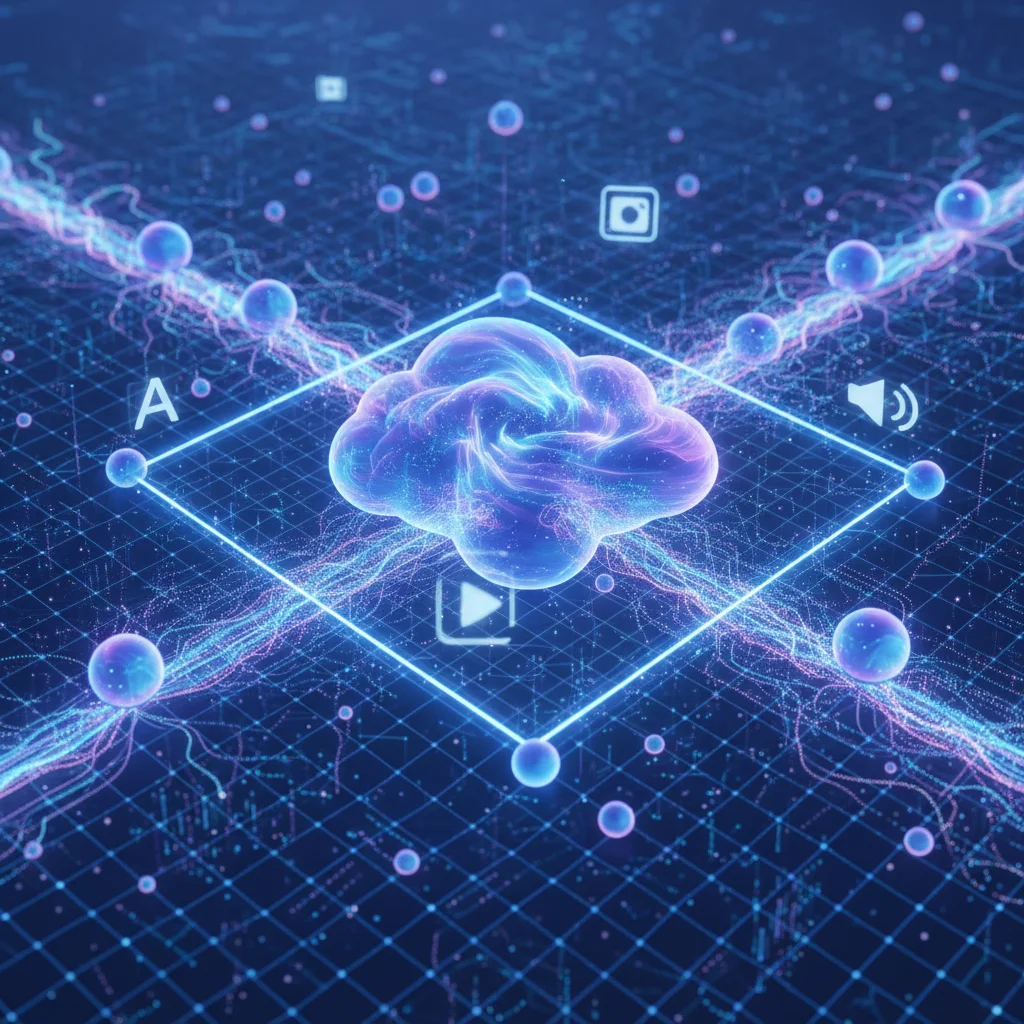
The Intelligent Enterprise: How Multimodal AI, Blockchain, and IoT Are Redefining Information Systems in 2025
Introduction: The New Information Systems Paradigm
Information systems have undergone a fundamental transformation over the past two decades. What began as static data repositories for enterprise resource planning (ERP) and customer relationship management (CRM) in the 2000s has evolved into intelligent, autonomous ecosystems capable of sensing, reasoning, and acting without human intervention. In 2025, this evolution has reached a critical inflection point: the convergence of multimodal large language models (LLMs), blockchain-based data integrity, and the Internet of Things (IoT) is giving birth to a new layer of business intelligence that is real-time, trustworthy, and hyper-personalized.
The core thesis of this shift can be stated simply: enterprises are no longer just automating routine tasks; they are building self-learning decision-making networks that combine the perceptual capabilities of IoT sensors, the reasoning power of AI, and the immutability of distributed ledgers. The result is an intelligent enterprise that can predict supply chain disruptions, personalize customer experiences at scale, and audit every transaction with cryptographic certainty.
Key players driving this transformation include OpenAI (with GPT-5 and reasoning models), Anthropic (Claude 4.5), Meta (open-weight Llama series), and hyperscalers like Google (Gemini 3, Vertex AI), Amazon (Bedrock, AWS IoT), and Netflix (AI-driven recommendation infrastructure). But the story is not just about proprietary models—it is also about the rise of open-weight architectures that are democratizing access to enterprise-grade AI while preserving data privacy.
[IMAGE: An infographic showing the evolution of information systems from 2000s (ERP/CRM) to 2025 (AI-IoT-Blockchain convergence).]
---
The Rise of Multimodal Reasoning: How LLMs Became the Brain of the Enterprise
From Text-Only Chatbots to Native Multimodal Engines
When ChatGPT launched in late 2022, it captured the world’s imagination with its conversational abilities—but it was fundamentally text-only. By 2025, the landscape has shifted dramatically. Today’s frontier models—GPT-5, Gemini 3, and Claude 4.5—are natively multimodal: they process text, images, audio, and video in real-time, reasoning across modalities as naturally as humans do.
Consider how a modern enterprise uses these capabilities. A logistics manager can upload a photo of a damaged shipping container, speak a voice query about its contents, and receive a written analysis that cross-references historical damage reports, weather data, and inventory records—all in a single prompt. This multimodal fusion represents a quantum leap over the siloed systems of the past.
Reasoning Models and Autonomous Agents
The introduction of chain-of-thought reasoning models has been equally transformative. OpenAI’s o-series models (including o3 and successors) and DeepSeek’s R1 family employ step-by-step logical inference to solve complex problems, enabling AI agents to act autonomously. These agents can break down multi-step tasks—such as negotiating a supplier contract or optimizing a factory production schedule—without needing constant human oversight.
For enterprise architects, this means that LLMs are no longer just chatbots. They are the reasoning layer that orchestrates workflows across databases, APIs, and IoT devices. GitHub Copilot and Cursor have already demonstrated how AI can write, review, and deploy production code. In finance, BloombergGPT achieves near-human accuracy in analyzing earnings calls and regulatory filings. In healthcare, domain-specific models trained on HIPAA-compliant data assist clinicians with diagnosis and treatment planning.
Long Context Windows: The End of Document Silos
One of the most underappreciated technical advances is the expansion of context windows to up to 2 million tokens. This allows enterprises to feed entire legal contracts, technical manuals, or customer interaction histories into a single AI prompt. Amazon uses such capabilities to analyze product reviews and return patterns across millions of customers, dynamically adjusting inventory and pricing. Netflix’s recommendation engine, already AI-driven, now leverages multimodal insights from viewing history, audio cues, and even scene analysis to predict what subscribers will watch next.
[IMAGE: Visual of a multimodal input (text, image, audio) feeding into a neural network, outputting a decision dashboard.]
---
Blockchain as the Trust Layer: Data Integrity and Transparency in a World of AI-Generated Content
Why Trust Matters More Than Ever
As AI-generated content proliferates—from synthetic images to automated financial reports—the question of provenance has become existential for enterprises. How can a decision-maker trust that the data feeding an AI model has not been tampered with? How can regulators verify that an automated contract was executed correctly? The answer lies in blockchain’s core attributes: immutability, transparency, and decentralization.
In 2025, blockchain has matured from a cryptocurrency novelty into a critical infrastructure component for information systems. Every piece of data that enters an AI model—whether from an IoT sensor, a customer database, or an external feed—can be hashed and recorded on a permissioned ledger. This creates an indelible audit trail that is resistant to retroactive modification, a property known as provenance integrity.
Verifying AI-Generated Outputs and IoT Data Streams
The synergy between blockchain and AI works in both directions. When an LLM generates a response—say, a medical diagnosis or a supply chain recommendation—the underlying reasoning steps and input data can be logged on-chain. This allows auditors to trace exactly which documents and sensor readings informed the decision. In regulated industries like pharmaceuticals, where batch records must be preserved for decades, blockchain ensures that AI-generated summaries are verifiable against original data.
Similarly, IoT devices are inherently vulnerable to manipulation if their sensor readings can be altered before reaching the AI layer. A temperature sensor reporting 30°C instead of 60°C could ruin a cold chain shipment for vaccines. By integrating blockchain at the device level—a concept known as “IoT with on-chain attestation”—each reading is cryptographically signed before transmission. The AI model then only processes data that has been validated on-chain, dramatically reducing the risk of garbage-in, garbage-out.
Smart Contracts and Trustless Automation
Perhaps the most powerful hybrid application is the integration of smart contracts with IoT data and LLM reasoning. Consider an insurance use case: an IoT sensor detects a water leak in a warehouse. The data is recorded on-chain, triggering a smart contract that automatically files a claim, verifies the policy terms (as interpreted by an AI agent), and initiates a payment—all without human intervention. The entire process is transparent, irreversible, and auditable.
Real-world implementations are already visible. In food safety, Walmart’s blockchain-based traceability system allows it to track mangoes from farm to store in seconds instead of days. When combined with AI-powered quality checks (using computer vision on IoT camera feeds), the system can automatically quarantine contaminated batches before they reach consumers. Pharmaceutical companies are deploying similar systems to combat counterfeit drugs, with blockchain providing an unbroken chain of custody that AI agents can query in real time.
[IMAGE: A diagram showing IoT sensors sending data to a blockchain ledger, with an AI model querying the ledger and triggering a smart contract.]
---
IoT-Blockchain Synergy: The Infrastructure for Supply Chain Resilience and Hyper-Personalization
The Commoditization of Intelligence
One of the hidden economic logics driving the adoption of these technologies is the commoditization of intelligence. Five years ago, building a custom AI model required millions of dollars in hardware, data annotation, and machine learning expertise. Today, open-weight models like Meta’s Llama 3.2 and Mistral’s latest releases can be fine-tuned on enterprise data with modest compute budgets. This democratization allows even mid-sized companies to deploy multimodal AI and blockchain-based IoT systems that were previously the domain of tech giants.
The result is a shift in competitive dynamics: the value is no longer in owning the AI, but in owning the unique data streams and trust infrastructure. Enterprises that combine IoT sensor networks with on-chain data integrity gain a moat that is difficult for competitors to replicate, because the data assets themselves become part of the system’s intelligence.
Supply Chain Resilience Through IoT-Blockchain Integration
Global supply chains are notoriously fragile, as the pandemic, geopolitical tensions, and climate events have repeatedly demonstrated. In 2025, leading enterprises are using a three-layered approach to build resilience. At the physical layer, IoT devices—GPS trackers, temperature loggers, vibration sensors—generate a continuous stream of real-time data. At the trust layer, blockchain records this data with cryptographic certainty. At the intelligence layer, multimodal AI models analyze the cross-referenced data to predict disruptions before they occur.
For example, a shipping container carrying electronics might broadcast its location, temperature, and humidity every five minutes via satellite IoT. If the AI model detects an unusual route deviation combined with temperature anomalies, it can autonomously reroute the shipment, order replacement parts from a nearby warehouse, and update the customer’s delivery window—all recorded on-chain for dispute resolution. This level of automation was unthinkable a decade ago; today it is becoming standard operating procedure for early adopters.
Hyper-Personalization at Scale
The same convergence is reshaping customer-facing systems. Retailers and media platforms have long used AI for recommendations, but 2025’s approach is radically more granular. An e-commerce site can now blend a user’s browsing history (text), product images (visual), past purchase audio notes from customer support calls (audio), and live inventory data from IoT shelf sensors to generate a real-time personalized offer. Because the underlying data is backed by blockchain, the user can see exactly how their data was used—a crucial trust factor in an era of privacy regulation.
Netflix provides a vivid example: its recommendation engine now incorporates multimodal signals such as scene-level audio descriptors and viewer emotional reactions captured via smart TV cameras (with opt-in consent). This enables the platform to suggest content not just based on what you watched, but how you watched it—and the personalization is transparent thanks to on-chain consent logs.
[IMAGE: A flowchart illustrating how IoT data (sensors), blockchain (ledger), and AI (LLM) combine to produce a personalized customer experience.]
---
Industry Dynamics: The Proprietary vs. Open-Source AI Race and Its Implications for CIOs
The Two Tracks of AI Deployment
The enterprise AI landscape in 2025 is defined by a clear bifurcation. On one track, proprietary models from OpenAI, Anthropic, and Google dominate use cases that demand cutting-edge reasoning and multimodal fluency. GPT-5 and Claude 4.5 are the engines behind many of the most sophisticated autonomous agents. On the other track, open-weight models—led by Meta’s Llama, the DeepSeek series, and various Mistral variants—are gaining traction in sectors where data privacy, regulatory compliance, or cost control are paramount.
Financial institutions, for instance, often cannot send customer data to third-party APIs. They run open-weight models on their own infrastructure, fine-tuning them on private data while keeping the blockchain-based audit trail internal. Pharmaceutical companies follow a similar path, using open models to analyze clinical trial data without violating HIPAA or GDPR.
Actionable Insights for CIOs and Enterprise Architects
For CIOs evaluating information systems strategy in 2025, three themes are emerging:
1. Adopt a modular AI stack that can switch between proprietary and open-weight models as needs change. Avoid vendor lock-in by using standard model serving frameworks (e.g., vLLM, TensorRT-LLM) and separating the reasoning layer from the data layer.
2. Embed blockchain at the data ingestion point, not as an afterthought. Every IoT device, every API call, every manual data entry should be hashed and recorded before it reaches the AI model. This ensures that trust is built into the system architecture rather than bolted on later.
3. Invest in multimodal-first design thinking. The days of separate text-only chatbots and image-analysis tools are ending. Enterprise applications should be designed from the ground up to accept and combine multiple input types, with long context windows that enable holistic analysis.
The Role of Cloud and Big Data Analytics
None of this would be possible without the underlying cloud infrastructure that provides the compute power for AI inference, the storage for blockchain ledgers, and the streaming analytics for IoT data. Amazon Web Services, Google Cloud, and Microsoft Azure have all launched integrated suites that combine managed AI services (e.g., AWS Bedrock), blockchain services (Amazon Managed Blockchain), and IoT platforms (AWS IoT Core). These platforms abstract away much of the complexity, allowing enterprises to focus on business logic.
Big data analytics tools like Apache Spark and Databricks have also evolved to natively support multimodal data, enabling data scientists to train models on text, image, and time-series sensor data within the same pipeline. The convergence at the infrastructure level mirrors the convergence at the application level.
[IMAGE: A cloud architecture diagram showing interconnected services: IoT ingestion, blockchain ledger, AI inference, and big data analytics, with arrows indicating data flow.]
---
Conclusion: The Road Ahead for the Intelligent Enterprise
The integration of multimodal AI, blockchain, and IoT represents more than a technological upgrade—it is a fundamental rearchitecting of how enterprises perceive, decide, and act. In 2025, the most successful organizations are not those that adopt any single technology in isolation, but those that weave all three into a cohesive fabric where data flows seamlessly from sensors to ledgers to reasoning engines.
Challenges remain. The proprietary vs. open-source tension will continue to evolve, potentially leading to regulatory pressure. Energy consumption of large-scale AI inference and blockchain consensus mechanisms is a growing concern. And the human element—ensuring that employees and customers trust systems that operate with increasing autonomy—requires careful change management.
Yet the direction is clear. Information systems have progressed from passive record-keepers to active participants in business operations. The intelligent enterprise of 2025 is not a distant vision; it is being built today, line by line of code, byte by byte of sensor data, block by block of cryptographic trust. For CIOs and enterprise architects, the time to act is now—before the convergence becomes a competitive necessity rather than a strategic advantage.

