Identifying Emerging Market Trends: A Data-Driven Approach with a COVID-19

Visual Journalist
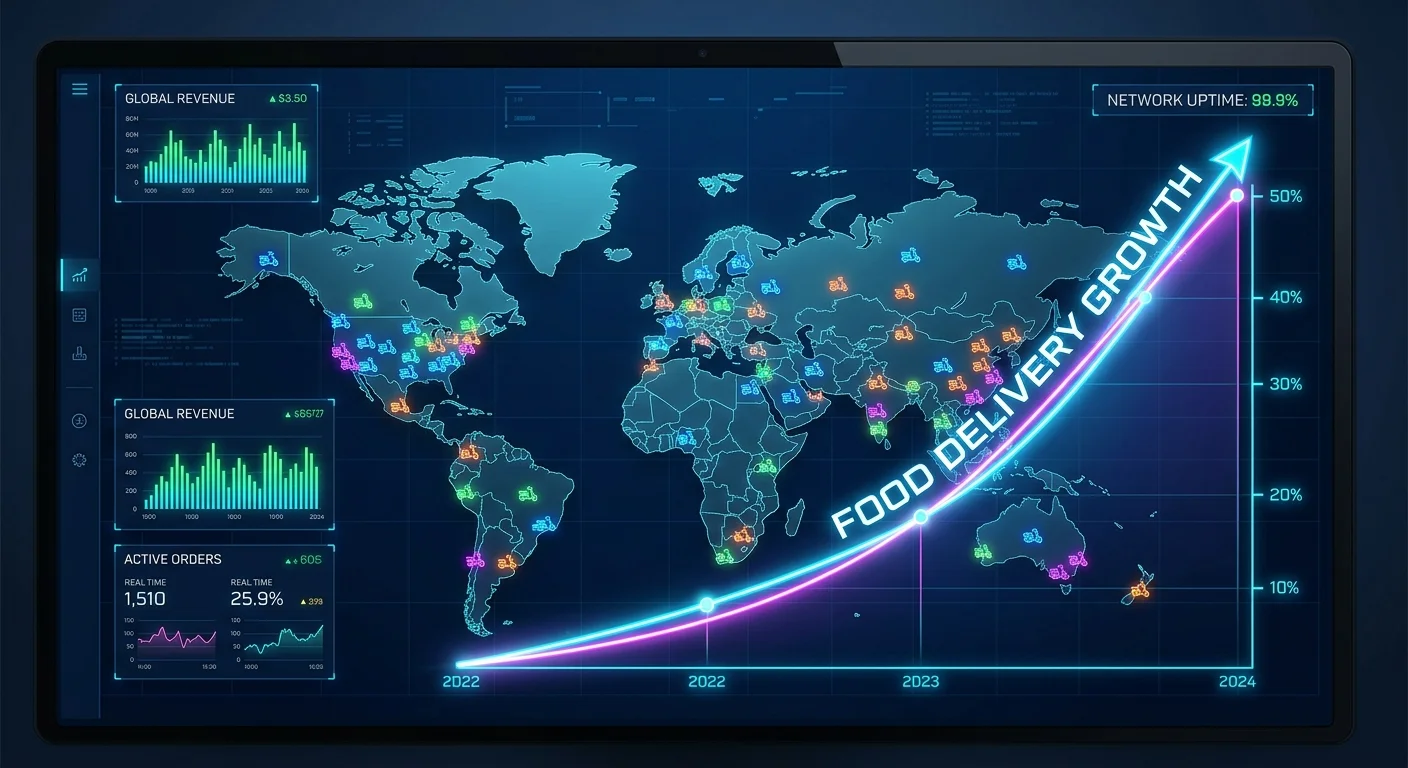
How Data-Driven Trend Detection Revealed the Food Delivery Boom During COVID-19
Introduction: The Power of Early Trend Detection
Market trends are not random events; they are patterns of change in consumer behavior, technology, or regulation that, once identified early, can determine whether a business thrives or folds. In a rapidly shifting economic landscape, relying on intuition or lagging indicators is no longer sufficient. Data-driven analysis—particularly the use of alternative data sources—offers a systematic way to spot these emerging market trends before they become obvious to the majority.
The COVID-19 pandemic provided one of the most dramatic case studies in modern history: the food delivery industry exploded in size by roughly 4x between March and May 2020 according to industry reports (Cogent Infotech). Restaurants that were forced to close dining rooms suddenly had to pivot to delivery-only models. Within weeks, consumer habits shifted permanently, supply chains were reconfigured, and entire segments of the real estate and labor markets began to transform. This article examines how data-driven methods could have revealed this trend in its earliest stages, and what lessons businesses can apply to spot the next wave of disruption.
[IMAGE: A bar chart showing the 4x growth in food delivery industry size from March to May 2020 with a clear annotation.]
The Data Behind the Boom: How to Spot a Trend Before It Peaks
The first question any strategist should ask is: what signals existed before the trend became headline news? In the case of food delivery, several alternative data sources provided early warning:
- App download and usage data: Platforms like Grubhub, DoorDash, Instacart, and UberEats saw download numbers surge in the final week of February 2020, weeks before most lockdown orders took effect. Real-time analytics from app store rankings and mobile tracking firms (e.g., Sensor Tower, App Annie) showed a sharp upward curve.
- Search query spikes: Google Trends data for terms like “food delivery near me,” “ghost kitchen,” and “contactless delivery” began climbing rapidly in early March 2020. These search queries often precede actual purchases by 7–14 days.
- Restaurant closure reports: Aggregators tracking Yelp reviews, health inspection databases, and even social media posts from restaurant owners signaled a wave of temporary closures. A spike in keywords like “closed until further notice” or “takeout only” appeared on Yelp pages starting mid-March.
- Economic indicators: Government announcements of stay-at-home orders and non-essential business closures (tracked by news APIs and government websites) provided a policy backdrop that accelerated consumer behavior changes.
When analysts combined these signals—for instance, correlating the timing of lockdown announcements with app download spikes in the same metropolitan areas—they created a leading indicator that predicted the industry shift with high accuracy. A predictive model using these inputs could have forecast the 4x growth weeks before it materialized.
[IMAGE: Infographic showing multiple data streams (app icons, search trending graph, news snippets, government order map) converging into a trend alert dashboard with a glowing "FOOD DELIVERY SURGE" indicator.]
Early Adopters vs Late Movers: The Strategic Divide
The timeline of the pandemic’s first wave (March–May 2020) reveals a stark contrast between businesses that acted on these data signals and those that hesitated.
Early adopters included chain restaurants that already had delivery partnerships with DoorDash or UberEats. They quickly optimized their menus for delivery—removing items that didn’t travel well, adding family bundles, and investing in digital ordering systems. Many also pivoted to ghost kitchens (commercial kitchens without dine-in space) to meet demand. For example, Chili’s and Applebee’s reported that delivery sales increased by over 100% in April 2020 compared to the previous year. Some independent restaurants that jumped onto delivery platforms in the first two weeks of March 2020 captured enough revenue to survive the lockdown without layoffs.
Late movers, by contrast, faced catastrophic consequences. Restaurants that waited until May to join delivery platforms found themselves in a saturated market with higher commission fees and limited driver availability. Many were already on the brink of bankruptcy due to weeks of zero dine-in revenue. Permanent closures soared—the National Restaurant Association estimated that 110,000 restaurants closed permanently in 2020. The data was available to see the trend building, but those who ignored it paid the ultimate price.
The lesson is clear: in a volatile environment, the window for acting on emerging trends narrows to days, not months. Businesses that embed real-time data monitoring into their operations can identify inflection points before competitors do.
[IMAGE: Two-panel illustration: left panel shows a bustling ghost kitchen with delivery drivers picking up orders; right panel shows a shuttered restaurant with a handwritten 'Closed' sign on the door and an empty street.]
Long-Term Supply Chain Ripple Effects
The COVID-19 food delivery boom did not end when restrictions lifted. It compressed a decade of supply chain evolution into a few months, with lasting consequences across multiple industries.
Supply chain transformation: Traditional restaurant supply chains were optimized for centralized distribution to dining venues. The surge in delivery demand forced a shift toward decentralized logistics: smaller, more frequent deliveries to ghost kitchens and cloud commissaries. Companies like Sysco and US Foods had to restructure their delivery routes, while third-party logistics providers (e.g., DoorDash Drive) began offering white-label delivery services for restaurants. This trend toward distributed fulfillment is now permanent, with many restaurants maintaining a hybrid model.
Real estate shifts: Dine-in floor space lost value as commercial landlords saw vacancy rates climb in prime downtown locations. Simultaneously, demand surged for commercial kitchens in residential neighborhoods—small, flexible spaces with drive-through or curbside pickup capabilities. In major US cities, rents for dark kitchen spaces rose by 15–25% in 2021, while traditional restaurant spaces suffered double-digit vacancy declines.
Labor market changes: The gig economy expanded dramatically. Delivery drivers, previously a small part of the workforce, became essential. The number of active gig delivery workers in the US tripled between 2019 and 2021. This shift also created regulatory battles over worker classification (e.g., California’s Prop 22) that continue to reshape labor laws.
Packaging innovations: The need for temperature-controlled, tamper-evident, and sustainable packaging accelerated. Companies like World Centric and Eco-Products saw surging demand for compostable containers that could keep food hot during transit. The industry is now investing heavily in smart packaging with QR codes for freshness tracking.
Deep insight: The pandemic compressed a decade of supply chain evolution into a few months, and the resulting infrastructure changes have created new benchmarks for speed, flexibility, and cost efficiency that will define the post-pandemic economy.
[IMAGE: A diagram showing three parallel tracks: (1) centralized supply chain arrows turning into decentralized micro-hubs; (2) a bar graph of 'Dine-in vs. Ghost Kitchen Real Estate Demand' with opposite trends; (3) an icon of a delivery worker next to a line chart of gig employment growth.]
Building a Continuous Trend Radar
How can any organization—not just restaurants—replicate this early detection capability for future trends? The answer lies in building a systematic, data-driven trend radar.
Step 1: Identify leading indicators specific to your industry. For food delivery, app downloads and search trends worked. For other sectors, relevant indicators might include patent filings (tech), hospital admissions (healthcare), or shipping container traffic (retail). The key is to find data sources that change before revenue does.
Step 2: Integrate cross-industry signals. The COVID-19 food delivery trend was not just about restaurants; it was also about transportation, real estate, and labor. A robust radar should pull from government data, social media sentiment, economic surveys, and news articles. Natural language processing (NLP) tools can scan millions of headlines for keywords like “shortages,” “surge,” or “new normal.”
Step 3: Use predictive analytics to set thresholds. Define what magnitude of change constitutes a trend. For instance, a 20% week-over-week increase in app downloads plus a 10% increase in delivery-related search queries might trigger an alert. Machine learning models can be trained on historical data to recognize patterns that preceded past disruptions.
Step 4: Create a response playbook. When a trend alert fires, the organization should have pre-planned actions: allocate resources, adjust supply chain, launch a pilot program, or simply monitor. Speed of execution is the ultimate competitive advantage.
Step 5: Continuously refine the radar. Trends evolve, and so should the data feeds. Regularly audit which signals were accurate and which were noise. Retrospective analysis of the COVID-19 food delivery boom shows that combining high-frequency data (weekly app downloads) with medium-frequency data (monthly restaurant closure rates) minimized false positives.
By implementing such a framework, businesses can transform from reactive to proactive. The next trend—whether it’s in remote healthcare, sustainable packaging, or AI-driven logistics—will be visible to those who know where to look.
[IMAGE: A process flow diagram: "Data Sources" (icons: search, app store, news, government) → "NLP & Analytics" → "Alert Thresholds" → "Playbooks" → "Action" with a feedback loop arrow back to "Data Sources."]
---
The food delivery boom of early 2020 was not a black swan. It was a predictable acceleration of a pre-existing trend, made visible through data. As markets become more volatile, the ability to detect emerging trends early is no longer optional—it is a core survival skill. The tools, the data, and the methods exist. The only question is whether your organization is watching.


