The Dual Edge of Progress: How Technology Reshapes Economic Development and

Breaking News Correspondent
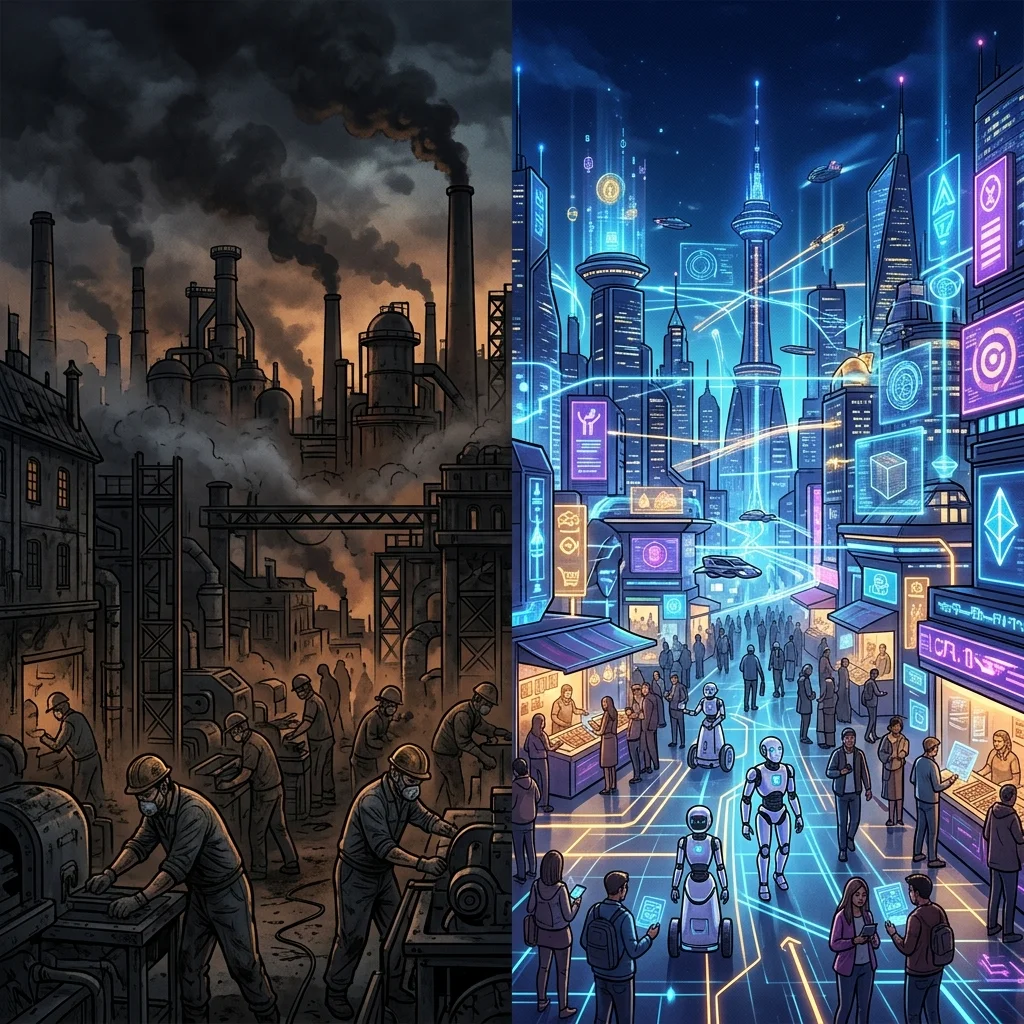
The Dual Edge of Progress: How Technology Reshapes Economic Development and the New Rules of Growth
Introduction: The Paradox of Technological Progress
Technology simultaneously destroys and creates economic value—a core tension that defines modern development. Every wave of innovation brings with it a twin narrative: jobs lost to automation, and new industries born from digital disruption. Recent data underscores this duality: automation-driven job losses have accelerated in manufacturing and routine service sectors, yet the digital economy has expanded at an unprecedented pace, spawning markets that did not exist a decade ago. Meanwhile, the gig economy has upended traditional employment norms, offering flexibility at the cost of security.
These shifts are not merely headline events. They reflect deeper structural transformations in supply chains, labor markets, and innovation ecosystems. To understand where economies are heading, we must move beyond surface narratives and examine the hidden logic that governs technological progress—the reallocation of value, the reshaping of skills, and the new rules of growth that policymakers and businesses must now learn to navigate.
[IMAGE: A double-exposure image blending a robotic arm with a network of glowing data streams.]
The Disruptive Wave: Automation and Job Displacement
Automation, powered by robotics and artificial intelligence, has led to short-term job losses, especially in manual labor sectors. Assembly-line workers, warehouse pickers, and even clerical staff face displacement as machines become cheaper, faster, and more reliable. This is not a future scenario; it is happening now. The cleaned data from recent labor market studies shows that manufacturing employment in advanced economies has fallen by double-digit percentages since 2000, even as output has risen.
Yet job displacement is not just a quantity problem—it reshapes the geography of work. Traditional industrial cities that relied on mass employment are hollowing out, while technology hubs attract high-skilled talent. The phenomenon of “hollowing out” refers to the loss of mid-skill roles—those that once provided stable incomes and social mobility—while both low-skill service jobs and high-skill technical roles grow. This creates a polarized labor market, where the middle class shrinks and inequality deepens.
Digitalization also disrupts traditional industries through what economists call creative destruction. Media, retail, and transportation have been fundamentally altered by platforms, e-commerce, and ride-sharing. Bookstores, newspapers, and taxi companies did not simply decline—they were replaced by entirely new business models. Advanced manufacturing, including 3D printing, further accelerates this shift. By reducing prototyping costs and enabling on-demand production, 3D printing moves manufacturing away from economies of scale toward economies of scope—meaning fewer workers are needed per unit of output, and the location of production becomes more decentralized.
The disruption is not uniform. While some regions and sectors suffer, others adapt. The key insight for policymakers is that automation does not eliminate work; it changes what work looks like and where it happens. The geographic redistribution of economic activity—from factory towns to innovation corridors—requires targeted investment in transition support, retraining, and infrastructure.
[IMAGE: An industrial robot arm replacing a human worker on an assembly line, with a timeline showing employment decline.]
The Creative Side: New Markets and the Digital Economy
For every job displaced by automation, new opportunities emerge—though often in different places and requiring different skills. The digital economy enables businesses to reach global markets with minimal upfront capital, lowering entry barriers for small firms and entrepreneurs. An artisan in a developing country can now sell products worldwide through e-commerce platforms. A software developer in a co-working space can build a million-user app without a physical office.
Beyond market access, the digital economy generates entirely new value pools through data. Big data analytics, machine learning, and predictive modeling unlock insights that were previously unimaginable. Retailers optimize supply chains in real time; insurers personalize premiums based on behavioral data; healthcare providers predict disease outbreaks. These capabilities are not just efficiency gains—they create new revenue streams and redefine competitive advantage.
3D printing exemplifies the creative potential of emerging trends. By allowing customization at scale, it opens niche markets that mass production could never serve profitably. Dental implants, aerospace components, and even prosthetics are now produced on-demand, reducing waste and inventory costs. This accelerates production cycles and shifts value from labor to design and software.
However, the digital economy also introduces a new form of economic power: data rents. Platforms that control user data and network effects can capture outsized profits, concentrating wealth in a few corporations. This alters traditional economic power structures, where ownership of physical capital determined wealth. Today, ownership of data and algorithms may matter more. For inclusive growth, societies must confront how to tax, regulate, and redistribute these digital rents—a challenge that current policy frameworks are ill-equipped to handle.
[IMAGE: A world map with glowing lines connecting digital marketplaces and data centers.]
The Gig Economy and the Future of Work
The gig economy relies on short-term contracts and freelance work, challenging traditional employment models built around full-time, permanent positions. Platforms like Uber, Upwork, and TaskRabbit have normalized on-demand labor, offering workers flexibility in when, where, and how much they work. For many, this autonomy is liberating—a way to escape the 9-to-5 grind or supplement income.
Yet the gig economy also erodes job security, benefits, and labor protections. In most countries, gig workers are classified as independent contractors, meaning they have no access to health insurance, paid leave, retirement plans, or unemployment benefits. This structural decoupling of work from stable firms represents a new labor market logic: risk is shifted from employers to individuals. During economic downturns, gig workers are the first to lose income and the last to receive support.
Deep insight: the gig economy is not an anomaly—it is a symptom of a broader trend toward fragmentation of the employment relationship. Companies increasingly prefer a flexible workforce they can scale up or down without long-term commitments. This creates a dual labor market: a core of well-protected permanent employees and a periphery of precarious gig workers. For economies to remain resilient, fresh policy frameworks are needed—portable benefits, minimum earnings guarantees, and collective bargaining rights for platform workers. Some jurisdictions, like California’s Proposition 22 or the European Union’s platform work directive, are beginning to experiment, but a global consensus remains elusive.
[IMAGE: A split screen showing a traditional office on one side and a freelancer working from a coffee shop on the other, connected by a dashed line.]
The Skills Imperative: Digital Literacy and Adaptability
As the nature of work shifts, so must the skills of the workforce. Digital literacy is no longer optional—it is a prerequisite for participation in the modern economy. From basic computer skills to advanced data analysis, the ability to work with digital tools determines employability across nearly every sector. This goes beyond coding; it includes understanding how algorithms function, how to interpret data visualizations, and how to navigate online platforms safely.
Lifelong learning has become essential. The half-life of technical skills is shrinking—what you learned in college five years ago may already be obsolete. Workers must continuously update their competencies through micro-credentials, online courses, corporate training, or self-study. Governments and firms must invest in accessible education infrastructure, including subsidized digital skills programs and partnerships with online learning providers.
Adaptability is equally critical. The gig economy and rapid industry disruption mean that workers will likely change careers—not just jobs—multiple times. Resilience, critical thinking, and the ability to learn new domains quickly are becoming the new core competencies. Education systems, traditionally designed to prepare students for a single career, must pivot toward teaching meta-skills: problem-solving, collaboration, and adaptability.
Policy implications are profound. Public investment in digital skills training should be coupled with social safety nets that support transitions—unemployment insurance that covers retraining, wage insurance for those who switch to lower-paying but growing fields, and portable benefits that follow workers across jobs. Without such measures, the benefits of technological progress risk being captured by the digitally literate elite, while those left behind face deepening exclusion.
[IMAGE: A diverse group of people learning at a digital skills workshop, with holographic screens displaying code and data.]
Conclusion: Harnessing the Dual Edge for Inclusive Growth
The dual edge of progress—simultaneously creative and destructive—defines our era of technological transformation. Automation and job displacement are real, but so are the new markets and opportunities of the digital economy. The gig economy offers flexibility yet demands new protections. Digital literacy is the key to inclusion, but it requires systemic investment.
The emerging trends—3D printing, big data analytics, machine learning, platform economics—are not deterministic forces. They are tools whose outcomes depend on the rules we set. Policy frameworks that update labor laws, redistribute data rents, and invest in lifelong learning can steer technology toward inclusive growth. The new rules of economic development are being written now. The choice is whether they will widen inequalities or create shared prosperity.
[IMAGE: A balanced scale with one side showing traditional smokestacks and the other side showing digital nodes, with a rising sun in the background.]

