2026 US Manufacturing Outlook: Turning Contraction into Opportunity Amid Trade

Breaking News Correspondent
2026 US Manufacturing Outlook: Turning Contraction into Opportunity Amid Trade Uncertainty
1. Introduction: The 2025 Contraction and the Road Ahead
The US manufacturing sector entered 2025 with cautious optimism but ended the year facing its most significant headwinds since the pandemic-era disruptions. The Institute for Supply Management’s Purchasing Managers’ Index (PMI) remained below the critical 50-point threshold for most of the year, signaling sustained contraction across the sector. This extended downturn, punctuated by readings as low as 47.3 in September 2025, marked the longest period of manufacturing contraction since the 2008 financial crisis.
[IMAGE: Chart showing PMI trend line through 2025 with shaded recession zone below 50, alongside a timeline of key events including tariff announcements and interest rate decisions]
Rising input costs, falling employment figures, and a steady decline in manufacturing construction spending compounded the headwinds. According to data from the US Census Bureau, manufacturing construction spending dropped 16.5% year-over-year in the third quarter of 2025, reversing the post-2022 boom driven by the CHIPS Act and Inflation Reduction Act.
Yet, beneath the surface of these discouraging metrics, industry experts see the seeds of transformation. Deloitte’s 2026 Manufacturing Industry Outlook, published on 13 November 2025, presents a nuanced picture: while the challenges are real and persistent, the companies that adapt strategically during this pivot point could emerge stronger. The contraction, the report argues, is not merely a downturn but a forced recalibration—one that rewards those who invest in technology, rethink supply chains, and prioritize resilience over efficiency.
2. Trade Policy Uncertainty: The Overwhelming Concern Reshaping Strategy
If there was one factor that dominated the conversation among manufacturers in 2025, it was trade policy uncertainty. More than three-quarters—76% to 81%—of manufacturers responding to the National Association of Manufacturers’ (NAM) quarterly outlook surveys throughout the year consistently identified trade uncertainty as their top concern. This figure held steady from Q1 through Q4, reflecting a persistent anxiety that few other issues could match.
[IMAGE: Infographic showing a map of North America with arrows indicating supply chain rerouting from Asia to Mexico and the US, with tariff icons and percentage symbols]
The root causes were multiple and interlocking. The expiration of key trade agreements, ongoing tariff disputes with major trading partners, and the unpredictable signals from Washington created an environment where long-term planning became nearly impossible. The threat of new tariffs on Chinese goods, followed by last-minute exemptions, then renewed enforcement, left procurement teams in a state of perpetual uncertainty.
“We can plan for a tariff increase of 10%. We can plan for 25%,” one senior supply chain executive at a Midwest automotive parts manufacturer told industry analysts. “But we cannot plan for 0% today, 25% next month, and 7% after a negotiation. That volatility is worse than any tariff level itself.”
This uncertainty is driving a hidden structural shift: a move from just-in-time (JIT) to just-in-case (JIC) supply chains. The JIT model, which dominated manufacturing for decades and emphasized minimal inventory and maximum efficiency, proved fragile during the pandemic. Now, trade policy volatility is accelerating its decline. Companies are holding larger buffer inventories, diversifying supplier bases across multiple countries, and prioritizing regionalization over global optimization.
Nearshoring, in particular, is gaining significant traction. Mexico overtook China as the top trading partner of the US in 2023, and that trend accelerated in 2025. Automotive, electronics, and medical device manufacturers announced over 40 major nearshoring projects in Mexico and the US during the year, representing combined investments exceeding $18 billion.
3. Declining Construction Spending: A Temporary Pause or a Signal of Structural Change?
The decline in manufacturing construction spending in 2025 demands careful interpretation, because it follows an extraordinary boom. Between 2022 and 2024, US manufacturing construction spending surged by over 180%, driven by federal incentives from the CHIPS Act, the Inflation Reduction Act, and the Infrastructure Investment and Jobs Act. Semiconductor plants, battery factories, and electric vehicle assembly facilities broke ground at a pace not seen in decades.
But by early 2025, that momentum began to stall. High interest rates—the Federal Reserve’s benchmark rate remained at 5.25% to 5.50% through most of 2025—increased the cost of capital for large-scale projects. Labor shortages in skilled trades, particularly electricians, pipefitters, and welders, delayed construction timelines. And trade policy uncertainty made it difficult for companies to commit to multi-year investment plans.
[IMAGE: Bar chart comparing manufacturing construction spending by quarter from 2022 to 2025, with annotations showing key legislation impacts and interest rate changes]
Is this a temporary pause or a structural shift? The evidence suggests it may be both.
On the temporary side, a pipeline of projects already approved under the CHIPS Act and IRA will continue to move forward, albeit more slowly. The semiconductor industry alone has committed over $230 billion in private investment since the CHIPS Act was signed, and cancelling these projects would be far more costly than pausing them. As interest rates show signs of stabilization in late 2025, construction activity is expected to rebound in 2026.
On the structural side, the nature of manufacturing investment is evolving. The boom of 2022-2024 was concentrated in megaprojects—gigafactories, chip fabs, and massive assembly plants. The next cycle, however, may be characterized by smaller, more flexible investments: retrofitting existing plants with automation, expanding capacity incrementally, and building regional distribution hubs rather than massive greenfield facilities. This shift aligns with the broader move toward supply chain resilience and regionalization.
4. Technology Investment: The Bright Spot in a Contraction
While many traditional manufacturing metrics weakened in 2025, investment in manufacturing technology showed remarkable resilience. Spending on industrial automation, artificial intelligence, and digital twin technologies grew by 8.3% year-over-year, according to data from the Association for Advancing Automation (A3).
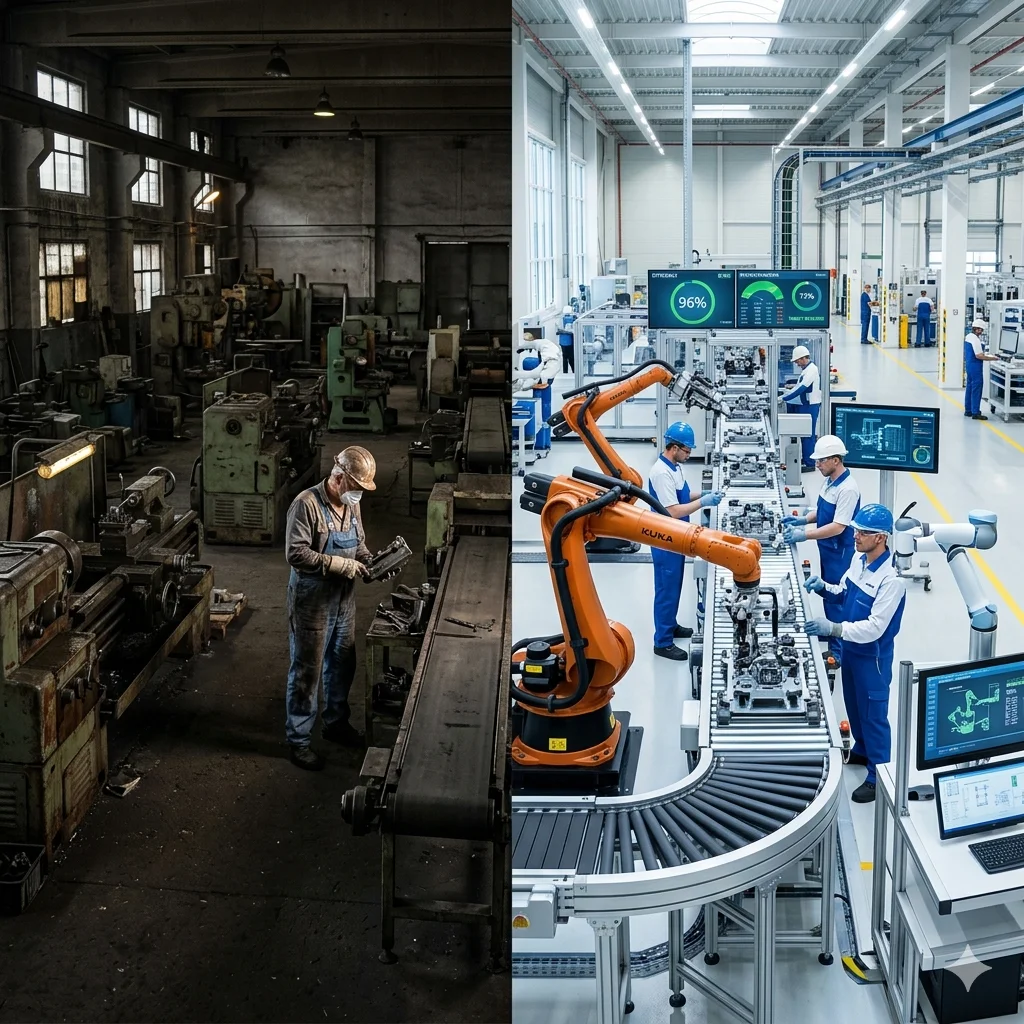
[IMAGE: Split panoramic image showing two factory scenes side by side. On the left, a dimly lit, outdated industrial floor with idle machinery and a lone worker in safety gear. On the right, a bright, high-tech automated production line with collaborative robots and digital monitors displaying real-time data]
This pattern is counterintuitive—why invest in new technology when the sector is contracting? The answer lies in the nature of the current downturn. Unlike demand-driven recessions, the 2025 contraction is largely structural and external, driven by policy uncertainty and supply disruptions. Companies are not seeing a collapse in demand for their products; they are seeing volatility in their ability to produce and deliver them efficiently.
Manufacturers are turning to technology to solve three interconnected problems: cost control, flexibility, and labor compensation.
Rising labor costs, driven by tight labor markets and wage inflation, are making automation investments more attractive. Collaborative robots (cobots) and autonomous mobile robots (AMRs) offer a faster payback period than traditional industrial robots, often under 18 months. And unlike large-scale automation projects that require months of shutdowns and retooling, cobots can be deployed incrementally, allowing manufacturers to adjust their investment pace to market conditions.
Digital twin technology, which creates virtual replicas of physical production systems, is gaining particular traction. By simulating production runs, testing configurations, and predicting maintenance needs before disruptions occur, manufacturers can reduce downtime, optimize throughput, and respond more quickly to changing orders.
“The manufacturers that are investing now are not just preparing for 2026—they are positioning themselves for the next decade,” said a senior partner at Deloitte’s manufacturing practice. “They understand that the companies that automate during downturns emerge with structural cost advantages that persist long after the recovery.”
5. The Shifting Architecture of Production Networks
The combination of trade policy uncertainty, technology adoption, and nearshoring is fundamentally reshaping the architecture of North American production networks.
Traditional supply chains followed a hub-and-spoke model, with critical components sourced from Asia and final assembly in the US or Mexico. This model optimized for cost but created single points of failure and long lead times. The new architecture is more distributed, with multiple production nodes, regional supplier ecosystems, and standardized platforms that can be adapted to local markets.
[IMAGE: Annotated diagram comparing traditional hub-and-spoke global supply chain with a distributed regional network model, showing nodes in the US, Mexico, and key Asian and European markets]
Three patterns are emerging:
First, regionalization is accelerating. Companies are building shorter, more localized supply chains that prioritize speed and reliability over absolute cost. This trend, which began during the pandemic, is now being reinforced by trade policy volatility. A survey by the National Association of Manufacturers found that 62% of manufacturers plan to increase their domestic sourcing over the next two years, up from 48% in 2023.
Second, supplier ecosystems are replacing linear chains. Rather than relying on a single Tier 1 supplier that integrates dozens of components, manufacturers are building networks of multiple, geographically proximate suppliers. This approach reduces lead times, increases redundancy, and allows for faster product customization.
Third, technology is enabling greater flexibility. Manufacturers are investing in automation and digital tools that allow them to switch between product configurations, adjust production volumes, and even shift between geographically distributed plants with minimal downtime. This flexibility is a direct response to the volatility of the current trade environment.
6. Conclusion: From Passive Resilience to Active Advantage
The US manufacturing outlook for 2026 is not about waiting for the storm to pass. It is about learning to navigate in turbulent waters.
The contraction of 2025 was painful, but it exposed weaknesses that had been building for years: over-reliance on extended supply chains, vulnerability to policy shocks, and a slow pace of technology adoption compared to global competitors. The manufacturers that survive—and thrive—in 2026 will be those that treat this moment as a catalyst for transformation, not just a period to endure.
Three imperatives emerge from the evidence:
Invest in technology as a strategic lever, not a cost center. Automation, digital twins, and AI are not luxuries for good times. They are tools for managing uncertainty, controlling costs, and building the flexibility that volatile markets demand.
Redesign supply chains for resilience, not just efficiency. Just-in-case is replacing just-in-time. This means redundant sourcing, regional production nodes, and inventory positioned strategically to buffer against disruptions.
Embrace trade uncertainty as a structural condition. Tariffs and trade policy volatility are not going to disappear in 2026. The most successful manufacturers will be those that build business models capable of adapting to multiple trade scenarios, rather than betting on a single outcome.
[IMAGE: A timeline graphic showing the progression from 2025 contraction to 2026 recovery, highlighting key milestones: technology investment inflection point, nearshoring acceleration, and supply chain resilience benchmarks]
The US manufacturing sector has faced existential challenges before and emerged transformed. From the decline of the Rust Belt to the rise of the South, from offshoring to reshoring, the industry has shown a remarkable capacity for renewal.
The contraction of 2025 is not the end of US manufacturing. It is the pivot point—the moment when passive resilience gives way to active advantage. For those who choose to act decisively, 2026 represents not just an opportunity to recover, but to build the next generation of American manufacturing.

